
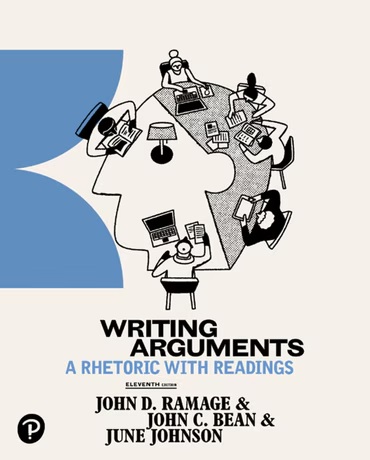
Writing Arguments A Rhetoric with Readings 11th Edition by Ramage TEST BANK
Original price was: $60.00.$30.00Current price is: $30.00.
Description
🧠 Test Bank for Writing Arguments: A Rhetoric with Readings (11th Edition)
Authors: John D. Ramage, John C. Bean, and June Johnson
ISBN-13: 9780134759746
Category: English Composition, Argument Writing, Rhetoric Studies
🌟 Part I: Principles of Argument
Chapter 1 – Argument: An Introduction
Learn the definition of argument, differences between explicit and implicit arguments, and explore how truth-seeking and persuasion shape every rhetorical process.
Chapter 2 – The Core of an Argument: A Claim with Reason
Understand issue vs. information questions, the classical structure of argument, and how to distinguish genuine from pseudo arguments.
Chapter 3 – The Logical Structure of Arguments (Logos)
Master formal and real-world logic through the Toulmin system and enthymeme. Analyze warrants, reasons, and rebuttals for stronger argumentative structure.
Chapter 4 – Using Evidence Effectively
Discover types of evidence and apply the STAR criteria (Sufficiency, Typicality, Accuracy, Relevance). Learn about ethos and source credibility while framing statistical evidence clearly.
Chapter 5 – Moving Your Audience: Ethos, Pathos, and Kairos
Develop persuasive power through appeals to logic, emotion, and credibility. Apply audience-based argument strategies and the rhetorical timing of kairos.
Chapter 6 – Responding to Objections and Alternative Views
Explore refutation and concession techniques and compare classical, one-sided, and delayed-thesis arguments.
🗣️ Part II: Entering an Argumentative Conversation
Chapter 7 – Analyzing Arguments Rhetorically
Study rhetorical context, audience analysis, and genre, purpose, and angle of vision.
Chapter 8 – Argument as Inquiry: Reading and Speaking Back
Practice summarizing stakeholder perspectives, dialectical thinking, and exploratory writing.
🎨 Part III: Expanding Our Understanding of Argument
Chapter 9 – Making Visual and Multimodal Arguments
Use visual design, color, layout, and typography to build strong advocacy ads, posters, and infographics.
Chapter 10 – An Alternative to Argument: Collaborative Rhetoric
Enhance empathy through active listening and finding common ground. Write open letters to promote shared understanding.
⚖️ Part IV: Arguments in Depth – Types of Claims
Explore all five major claim types: factual, definition, causal, evaluation, and proposal.
-
Definition & Resemblance Arguments: Use criteria-match and analogies.
-
Causal Arguments: Analyze causal chains and avoid logical fallacies.
-
Evaluation & Ethical Arguments: Apply categorical and principles-based ethics.
-
Proposal Arguments: Develop policy and problem-solution structures for real-world impact.
📚 Part V: The Researched Argument
Learn how to find, evaluate, and cite credible sources.
-
Chapter 16: Craft research questions and assess source credibility.
-
Chapter 17: Incorporate summary, paraphrase, and quotation ethically.
-
Chapter 18: Master MLA and APA citation styles and academic formatting.
📘 Appendix: Informal Fallacies
Recognize common fallacies and the difference between formal and informal logic in everyday arguments.
🔍 SEO Keywords
Writing Arguments Test Bank, John D. Ramage, Writing Arguments 11th Edition PDF, Rhetoric with Readings Answers, Argument Writing Textbook, Ethos Pathos Logos Examples, Toulmin Argument Model, Persuasive Writing Techniques, English Composition Resources, College Argumentative Writing, Rhetorical Analysis Study Guide, Argument Essay Structure, Academic Persuasion Skills, Critical Thinking and Logic.
https://testbankforyou.com/shop/